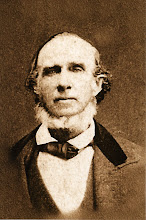
HISTORY OF JAMES OLIVERSON
(Information from Ray Oliverson)
Levi Earl Oliverson and James Oliverson’s Personal Journals
James Oliverson was born 3 March 1823, at Belmount Sharples, Lancashire, England. He was the 5th child out of a family of eight, six boys and 2 girls. His parents were John Oliverson and Esther Baron. The other members of the family were Christopher, born 17 December 1813; Baron, christened 7 January, 1815; Isabella, born 22 August, 1819; Nancy, born 21 August 1820; Robert, born 12 May 1825; John Beadsley, born 25 July 1827; and Richard Thomas, born about 1830. Christopher, Baron, Isabella and Nancy were born in Great Harwood, Lancashire, England. Robert and John were born at Pendleton, Lancashire, England. and Richard Thomas awas born at Great Harwood, Lancashire, England.
It was here in England where James spent his childhood, his father was a shoemaker. It seemed to be customary in those days for the father to teach their children, especially their sons, a trade similar to the one they pursued. James was also taught the trade of harness and tent making, which helped him after coming to America.
When James was 15 years old (1838) he joined the English Navy. He served with the Navy until their was a death in the family. He applied for a leave and his application was rejected. James was a person who knew his own mind and what he wanted to do. Upon finding that his application was not granted, he went AWOL to attend the funeral and eventually deserted the Navy.
During the remainder of his life in England he remained under cover, until he could find transportation out of the country. Eventually he obtained passage on a cargo ship, which was going to America. I (Mona Rogers) have a dinner plate that has been handed down to us, and we have been told that James brought this plate with him from England, and that he came to America when he was 17 years old. Earl Oliverson says he arrived in New York City, in 1848 or 49, but if he came over when he was 17, as his daughter Jennet has told us, it would be 1840. (Ray says he has heard that he came to New Orleans, then up the Mississippi).
During his stay in New York City he received a letter from his father, John Oliverson, telling him that he could obtain money that he would need, by going to a certain bank. Whether he ever drew any money from the bank is not known.
Apparently the family in England, were the owners of property, this is shown by the return of Richard Thomas Oliverson, James’ younger brother, to England in the late nineteenth century to obtain his share of the estate.
The California gold rush was a very tempting enticement for the young men of those days, especially those who weren’t married or had home ties. James having no reason to stay in New York City, decided that he would go to California and run his chances on stricking a rich claim.
It seems to have been the nature of James Oliverson to keep diaries and journals of his experiences most of his life and we have a few of these journals. Ray Oliverson has taken these journals and as I say translated them from James’ own hand writing and typed them, also had them micro-filmed at the Utah Historical Society Library.
I have gone thru these journals and picked out the most interesting parts, and hope everyone will enjoy them.
One of these journals was kept during the time he crossed the plains. It starts June 14 and ends July 18, but no year is given, and no mention of where they were started from, but he tells of a murder that happened in his July 4th entry, and he says; "this is the second case of this kind we have seen since we left Independence, so they must of started in Missouri. They traveled along the Platte River, with Ox teams, and make about 20 miles a day. June 17; "Iched up at 1/2 past 6 A.M. traveled the bottoms of the North Branch of the Platte River and camped 2 hours before sun-down at about 2 P.M. We had a heavy hail storm attended with heavy thunder and lightening, we had to hold our oxen, the hail stones was so large and heavy and the dogs around us were howling pittyfully. A company a little below let all their oxen break from them, they run and jumped in the river and stood in the middle for two hours, before they came back. The storm lasted about two hours, and 2 of our lose cattle served us the same, and we thought we would lose them."
June 25; "Our company was amusing themselves with violin and dancing. We are about 15 miles from Fort Laramie, we expect to make it today. Three of our company left us yesterday by horseback and went before us to the fort to make oxen shoes for the company, as our ox’s feet are getting lame, on account of there feet wearing through, traveled 24 miles today."
June 27; "After reaching the fort, we laid up here all day making ox shoe nails. We cannot hire a forge for love nor money to make them ourselves, blacksmiths here are charging $18.00 to shoe one oxen, and to avoid the imposition we have bilt a forge and cut old horse shoes in too and made ox shoes. Everything here is very dear and everyone trys to impose upon the Emigrants".
The next day one of their oxen was killed by lightening during a storm.
July 3; "Iched up this morning at 1/4 to 7 A.M. roads good with exception of them being rather hilly, water good and plenty of it. This morning we was in chase of Buffalo and fortunately we killed one and tomorrow the 4th July we expect to feast upon Buffalo Beef and celebrate the 4th of July, in luxery."
"Monday morning we cross the Platte River for the last time, we have traveled along the river now about 400 miles." As they traveled on they had some good days and some bad days, they passed over some alkili land, and many dead oxen along the way, they supposed to be poisoned by alkili water. One day their Oxen were without water for 18 hours, sometimes very poor feed for the stock." One place he mentioned it was eaten off by the earlier Emmigrants.
His last entry of this Journal was July 18; "Today we left the little Sandy and proceeded to the Big Sandy." By the abrupt ending of the Journal it would indicate that it was continued under another cover. It does not contain the complete trek from the east to Salt Lake City, where he seperated from the wagon train. It is believed that this was in the summer of 1849.
As the wagon train arrived in Salt Lake City on its journey to California they usually stopped to repair their wagons and replenish their supply’s. Shortly after James arrived in Salt Lake City, he had an interesting conversation concerning mormonism with a person who was doing some black-smithing work for him. Eventually he was converted and baptized a member of the Church of Jesus Christ of Latter-day Saints, he was baptized on 16 April 1951.
After a short stay in Salt Lake City he moved north to a settlement known as Kaysville, Utah. Here he continued the occupation of tent making, which he must have done in Salt Lake City. It was in Kaysville, he met a young lady by the name of Caroline Roberts, a daughter of Levi Roberts and Harriet Ann Hefford. After a short courtship James and Caroline were married on 30 September 1856 in Kaysville. She was 18 years old and he was 32. Caroline was born on 22 November 1837 in Chicksboro, Gloucester, England. Probably came across the plains with the Mormon Pioneers.
From this union came the birth of 12 children, 6 girls and 6 boys. Their first 5 were girls, they were; Esther Ellen born 25 September 1857 in Kaysville. Theodosia Ann 16 March 1859 also in Kaysville. Harriet Ann born in Franklin, Oneida Co., Idaho, as the rest of the family. Lucy Mary, 1 July 1862, she died as a child. Jennette, 24 Aug 1864. The the boys started coming; James Henry, born 11 May 1866. Levi Roberts, born 3 March 1868, on his fathers 43 birthday. Then the 6th girl; Matilda, born 31 March 1870. The last 4 were boys; John Besley, born 22 February 1872. Richard Thomas, 31 Mar. 1876. Christopher, 29 Dec 1877. William 2 August 1879. James was 56 years old when the last son was born. James and Caroline had their endowments in the Endowment House in Salt Lake City, November 22, 1862, and Caroline was sealed to her husband James the same day. It was her 25th birthday.
After a few years in Kaysville the family decided to move to Franklin, Idaho, where they homesteaded some land and made it their home for the rest of their lives. Franklin was a small settlement north of Logan, Cache, Utah, just across the line in Idaho, it was the first settlement that was organized in the state of Idaho in 1860.
The desire of the Mormon people was to settle as much of the Territory of Utah as possible. It was under the direction of the Mormon leaders that in the early spring of 1860, five companies from Provo, Payson, Slaterville, Kaysville and Bountiful, left Utah and came to Franklin in search of a new home. The first company came in April. James Oliverson was head of the first families who came to this area. (This information is located at the Utah State University Library, Logan, Utah. Microfilm No. 979:2 Reel; 1 Item 2).
The next few years was spent helping build up Franklin and getting a home, etc. for the family, and doing any kind of work he could find to make a living for his family. Many times he had to be away from home for months at a time working and sending money home to his wife. Thanks again to Ray Oliverson, we have some of these journals typed from Jame’s own hand writing. Now some of the more interesting parts of a journal kept while he was working on the Railroad in Utah and Idaho. The first one starts May 8 187-3 to August 1872-3. James should have been a weatherman, everyday he tells about the weather and about friends coming to see him at his camp and many times they spend the night with him, and many times they bring news from his home in Franklin. He always tells when he gets a letter from home and answers it that night or the next day. This shows his love and concern for his family, and how lonesome he was to be away from them. Many times he mentions the circus coming to town, even when he is at home in Franklin. On Sundays he spent his time reading and playing cards while he was in camps. On Sunday July 27 "In camp all day reading and washing clothes, I went to the creek and had a good wash all over". Again on Sunday August 14; "In camp all day sent 2 letters home today, one to my wife and other to my daughter Ann. We itched up a team and went down to the Grate Salt and had a bath, twelve in one wagon".
July 5 Saturday; I went to Salt Lake City today, I recieved $10.00 from J. Packer, he was indepted to me, we went to the Theater tonite, J. Packer bought 30 lbs of beef and veal, he left it in camp, some dogs eat it nearly all, he is about the most careless man I ever knew." Another day he says; "My shoe is lameing my left foot". He ends this Journal August 30, and then starts again 17 September 1883, so he must have been home for a couple of weeks, before going to work at Bair River Canyon, north of Franklin, to work building the railroad. The weekend of 26 September he came home with James Packer as he came to Franklin for supplies. September 27 Sat. "At home, things about home going to ruin for the want of care. I think that I will never go away again to work, but stop at home if I can." Sunday Sept 28; "At home all day reading, the girls of Franklin gone to Logan to a Jubelee for the young choirs of Cache Valley had a very fine time of it." As he got back to camp he had to commence on a company tent, many times in all his journals he is making tents and wagon covers for the people in the camps.
Oct 1; "Worked on the tent all day, finished a little after six o’clock." Oct 2; "Commenced working on the road this morning on Jas. Packer contract, made me very sore and tired by quiting time at night."
Oct 10 Friday; " Our work as we get along it becomes harder, and worth more per rod then we get. Jas Packer Jun. came out this afternoon and brought a letter to Robert Stalker that all work was to stop." Oct 11 Sat. "Worked 1/2 day, we worked till noon, then broke up camp and came home, got home after sun-down.
Now as far as we know he spent the next few years at home in Franklin. This Journal continues until Nov. 1, 1873. As he got home in Oct. it was harvest time, he helped James Haworth several days with his thrashing his crops. On Sundays he reads the New York Times, he subscribes for it by the year (the Sunday edition). He also says; "Commenced getting my potatoes up, they are very good and a good crop."
Oct 27; Monday "A licquer Saloon started in Franklin, not a very good instatation for the young men of this place and others indulge in such habits as drinking." On Nov 1, 1973 he says; "We expect a daily mail to Franklin from the 1st of the present month, it will be commeansante to the settlement north.
The next entry in this Journal is Jan 1, 1879 to May 23, 1879. Every year on the 3 Mar, he mentions that it’s his birthday and how old he is, also that it is Levi’s birthday too, sometimes he tells how old Levi is. Two of his girls were married in 1879. Ellen was married to Phineus Daily and lives at Bear Lake on the border of Idaho and Utah, but in 1883 she had moved to Arizona, because on December 12, 1883 he gets a letter from Ellen in Arizona. Ann married Darius Fellows and athey live in Rush Lake, Toole Co.
With no way to make a living in Franklin and raising a large family, for many years he worked in a lumber yard in Dillon, Montana. The first Journal we have from Dillon starts November 4, 1880 to September 25, 1882, so I will make a few notes from this Journal. Of course he always mentions the weather, most of the time its very cold and stormy. He works very hard here, like November 8 "Unloaded three cars (freight cars) of lumber today." He makes $45.00 a month and has to pay room and board and a lady to wash his clothes. He works for a man named Trask. November 25 Thursday; "This is a National Holiday for the people to worship and give thanks for the prosperity of the country. We had quit an extra dinner at the hotel.
He got to go home for Christmas this year but some years he spent Christmas in Dillon. On December 21, he says; "My Boss trying to get me a pass to go home." December 23; "Started home, things was all right. Had 3 engines on the train." December 24; "Arrived home at 3 o’clock this morning the children all right. James is doing well." James must have had a broken leg. "I settled with Webster, but have no money to go on, but out of dept with exception of the Dr. bill." December 25; "Christmas Day, very wet and sloppy walking out." December 28 Sunday; "Christmas went off very quite, went to the school in the evening they had a very nice tree loaded with presents for the children who attended their school, the occasion went off very nice."
James is able to stay home now until April 1881. January 9, Sunday; "At home, Very cold morning, snowing all day, some of the children went to Sunday School. A deal of sleigh riding by the people of Franklin." Very cold weather, the trains very unregular, and many train accidents. January 12, Wednesday; "Had a note from Miss Nobles, the school teacher, about James staying out of school, she wished me to see James about it, she seems anxious about her scholars and I believe she has a great interest in learning them." "I corrected James about his conduct and wished him to apoligized to Miss Nobles, and ask her forgiviness and that he wouldn’t do it anymore." James is 15 years old, natural for a 15 years old. James at this time bought an accordian payed $3.00 for it. January 19; "Had a note from the school teacher about the boys bad conduct at school, it greaves me very much if they do not do better. I hope they will observe the rules of the school. We had a Richmond band here to day, they played at the dance at night."
February 19; "The Franklin Dramatic Co. gave a free enternment tonight." March 14; "Had a run-away marriage last night, Lucy Woodward and Inkley, the operator at the depot. I am sorry to say that our Harriet let herself to carry the things out in going with them down to Richmond and being present. Mrs. Woodward feels very bad."
The first part of April 1881 he spent in James Chadwicks Camp working on tents and covers for horse blankets. Then moved to James Packers camp to fix tents and wagon covers. He went to several other camps, fixing tents. May 1, Sunday; "Got to Dillon about 9 o’clock, I went to see Mr Trask, I go to work in the lumberyard. I bought a trunk today, and wrote a letter home and put $2.00 in the letter." On Monday, he set out 14 current trees for Mr. Trask. The weather so bad that the passenger train had not left for three days.
June 24; "Mr Trask came and ask me to send for Harriet, he pays her passage up and down and gives her $3.00 a week." Harriet comes up and works for the Trask family from June 1881 until March 1882. November 9, Wednesda; "Harriet sent her sister Jennet a dress piece, by express this morning and veil in it." November 14, Monday; "I got a letter from home today, stating that Jennet had gone from home and was married to one by the name of Cutler, someone I know nothing about. I am grieved to think the girls respect their parents so little as to take such a step without seeing their parents about it. This is the second affair of this ind which has taken place in our family."
Many times he says, he posted a letter in the postal car, I suppose no post office in Dillon yet. He buys clothes for the children and sends home for them. He bought a coat for Matilda and paid $8.00 for it. He bought 3 overcoats for James, Levi and John paid $15.00 for them. Another time he bought 23 lbs of feathers and sent home, probably to make a feather bed.
December 25, 1881, Sunday; "Christmas Day, had some snow last night but all mixed up with dry dust. There was a heavy wind last night. Sun shining brightly but cold. I had a present of a nice pipe this morning but do not know who is the doner, as yet. Had a letter from home last night. Went to see the Christmas tree, looks very well and pretty. A good many presents on it for the children." The next day he found out the pipe was from his daughter Harriet.
January 1, 1882; "Had a fine day. I had Mr. Trask horse and buggy this afternoon, I took Harriet out to Peter Willson, we took dinner and had a nice time."
April 28, Friday; "Two barbers in this place have trouble and they have been fighting 2 days, one after the other. They feel bitter to one another one of them wants all the trade, the other wants his share of it, this is the dissagrement." Several times he says he went and got his hair clipt, another time he says; "I went and had my likeness taken today."
June 23, James has about 2 weeks off so he goes home to Franklin, this is the first time he has been home since March of 1881, 14 mounts away. His wife and 5 of the children met him at the depot in Franklin. "My wife went with me to Ogden. Arrived at my wifes folks about noon." June 24, Saturday; "I went down to Salt Lake City, with Henry Roberts (his brother-in-law) The improvements around this city is splended. I visited Brigham Young’s grave it is fixed up very nice." I believe his wife stayed at his parents while he went to Salt Lake City. They went home the next Wednesday. While he was home he went to Logan and bought a wagon, cost $130.00. July 6, 1882, Thursday; "Ileft home this evening for Dillon, Montana, very warm. Arrived in Dillon about 1/2 past 4 o’clock in the afternoon." July 25, Tuesday; "I wrote a letter home this morning and posted it. Fine weather. I feel very sick this morning and work is very hard on me but dept and misfortune compells me to hang on. I hope the sickness will soon wear off. I eat vaery little, not enough to keep my strength up, still hope for the best." August 1, Tuesday; "Very warm day. P. O. Neil give me a good sailors coat this morning. He gives up his hotel today. As I came out from dinner a fire started in the corner by Hack Nelson Sallon, a strong wind blowing from the south east. The fire has taken the whole of the block. All in ashes in one hour. Caused by boys playing with fire crackers. Burnt 12 places down. 3 Salloons, Butcher shop, Baker and others."
Christmas day 1882 was spent alone in Dillon. He wrote a letter home. January 1, 1883, Monday; Weather moderating a little, the theometer 10 degrees below zero, this is 11 degrees higher than yesterday. Very little business doing in Dillon at present time, still very cold."
March 3, Saturday; "I am 60 years old this morning, I have had a very hard days work, packing away dress lumber, had a letter from home this morning, all well, answered it tonight." March 18; "My boss tells me I can make a trip home." March 20; "I left Dillon for home, I bought my wife a gold ring I paid $4.00 for it." March 22; "There was a telegram from Jennet in Box Elder, that her baby was dead that morning." James and several family member went down to Box Elder. Caroline had 3 children home with the mumps. April 5; "my wife packed my trunk, as I purpose taking the train at 12 o’clock tonight James and Levi accoumpaned me to see me off, by the passenger train."
This next 16 months at Dillon, he is taking orders and selling butter to the hotel and boarding houses, besides his work at the lumberyard. His friends in Franklin supply the butter and is shipped up to Dillon on the train. It is over a hundred pounds a week, and most of the time it sells for 30 cents a pound.
August 17, Friday;" I went to the Dentist and had 5 teeth pulled out all I had, he is to make me a new set for $30.00."
August 31, Friday; "Had a fine day. I had the impression of my gums taken for a full set of teet this morning."
December 25; Christmas Day spent alone in Dillon. "The School House is decorated very nice for the Odd Fellows Ball. I have been told that 190 tickets sold for the ball and supper at $4.00 per ticket. There is a great many people in Dillon to spend Christmas."
In July 1884 he spent 2 weeks at home, he had some land business to attend to. July 3, 1884, Thursday; "I arrived home at 12/30 o’clock and find the family all well. I find a geat many strangers in Franklin." July 7; Jennet came up to see me from Mink Creek, she looks well." July 17, Thursday; " I left Franklin for Dillon on the passenger train, at 1 O’clock A good many passangers on the train. We arrived in Dillon at 5 o’clock this afternoon. August 15; "I paid Mrs Byther $16.00 bring my board-bill for the last month, commencing July 17.
The rest of the Journals are from Franklin, Idaho. They start July 9, 1888 to April 1893, so it is not known just when he came home from Dillon, Montana to stay. As he starts this Journal in July 1888 he is Postmaster in Franklin, he has to send a quarterly report to Washington D.C. every 3 months, he was postmaster until September 1889.
September 2, 1888, Sunday; "Caroline went over to Bodily’s (Her sister Ann’s place) ready to start south, down to Kaysville to her parents to dry some fruit." All of the boys help with the farm work, and go to the canyon to get wood for the winters, also helping to keep the fences mended. They must have a dry farm of wheat, he mentions several times about going out to see the wheat. He mentions getting a letter from his brother in Jacksonville, Illinois. (Lorenzo Cutler went on a mission to Illinois in 1897 until 1899, while he sill had a family at home, and he mentions in his Journal several times about visiting his wife’s Uncle John Oliverson in Illinois).
September 21, Friday; "Levi very weak and sore with the cramps." James started down for his mother this morning, he was in Logan about 9 o’clock, Our Richard went with him." There seems to be a lot of sickness in Franklin, Levi mending slowly.
October 1, James taken down sick. These 2 boys are very sick for several months especially James. On November 4, "We telegraphed to Logan for Doc. W. L. Snow to come by afternoon train, the boys met him at the depot, he tells me James is in a bad condition. He left some medicine and a perscription, he left with the understanding that he sends the medicine up and one bottle of brandy, he hired Edward Buckley to take him to Logan. James had a hard spell of coughing tonight between 7 and 9 o’clock.
November 7; "James had a bad night, I think the absess is broke inside, he spits up a great amound of offenceive stuff." November 26; James had a bad night, sent for the Doc. this morning, he arrived 1/2 pasat one o’clock, and operated on him, he took a lot of matter out of the lump. He has very little hopes of his recovery. I think he charges $15.00 for operating on him; $18.00 for coming up." The Doc. came back on December 4th and took out the tube and cleaned it and put it back, he has great hopes for him. Again on December 17 the Doc. took out the tube and left some pills.
December 25, 1888, Tuesday; "All hail Christmas day and a pleasent one." December 31, 1888, Monday; "The last day of 1888, the people dancing and feasting and seem to be happy." January 25, Friday; "My wife inclined to be sick with sitting up so much with James." The next day their daughter Jennet was taken sick, and she was sick for several days, her mother went over and stayed a day with her. James is doing better, James was married at this time of his sickness, but his wife was never mentioned. He lived in Franklin, because on the February 3rd entry, he says; "James walked over to our place today," and a few days later he says James walked to the office (post) today stayed down until about 4 o’clock then went home.
Levi starts a homestead of his own about this time, Harriet and Till attended the post office for their father one day while he helped Levi with legal matters.
April 5; "Levi and his Mother gone to Kaysville to see her parents. Levi goes on to Salt Lake City." April 6, Saturday; Very quite in Franklin, a good many people left for Salt Lake City, going to Conference which starts this morning."
April 30, 1889, Tuesday; "A National Holladay Celebrating the first Inaugural of the First President of the United States of America, 100 years ago which was George Washington."
September 14, Saturday; "Gorge give notice of taking the Post Office, Munday next."
September 16, Monday; "Fine day, turning over government property to Gorge Fordham today."
September 17, Tuesday; "At home all day fixing up things. Levi going to the canyon after fire wood."
October 2, Wednesday; "I bought 27 yards of flenell from Edward Buckley at 40 cents per yard." Harriet seems to be the seamstress in the family, several times he mentions Hariett making him garments and shirts.
October 8, Tuesday; "Took the train for Layton this morning, my wife’s folks are well, considering their age and dissapointed not to see Caroline. Till went with me to see her grand-parents." They went on to Salt Lake City and took 2 of Till’s cousins with them, they went on the Temple Block and in the Tabernacle.
October 11; "People all home again, it is claimed there was as much as 20,000 people at conference."
Octoaber 26, Saturday; "We had a beef killed today, I bought a 40 gallon barrall to salt it down in." There is a skip in his journal from October until February 1890, and this is the first time he mentions his wife’s illness, he says she’s been down about 4 weeks and Margaret Whitehead (James wife) is attending her, she is better and worse nearly every other day. All the rest of his Journals mentions about her illness, so I guess she was sick the last 10 or 11 years of her life. She died 29 July 1901, at the age of 65. Also in this February 18th and other times too, he says; "I had an attack of Chalria arbans and the La Grip. Had the Doc 3 times once for me and twice for my wife." On April 1st; "Caroline was able to go to Kaysville to see her parents, she had to walk to May Janes (her sisters) about one and a half miles. Caroline walked over to see her parents. While she was here in Kaysville she became very ill, the Doc examined her and finds that the womb is closed up, he made an inceshtion to clean it out. Her husband James went to get some cod liver oil, but couldn’t get the kind he wanted, so he took the train for home and bought a bottle of cod liver oil and came back to Kaysville. They were not able to come home until April 27, almost a month at her parents, Levi was as the depot with a team.
Several times he mentions that the girls come over and helping clean things up for him and helping with their Mother, but by August 1892 he writes; "It looks as though I am distined ato do house work for the rest of my days."
November 8, 1892, Tuesday; "The great day of election, for President of the United States. I voted for Cleveland and Steveson, I think they will be elected, I hope so."
December 30, 1892; "Harriet was confined to bed this morning, she had a girl baby born."
January 3, 1893; "Our Till was confined to bed this morning with a fine baby boy, 11 pounder."
January 8, Sunday; "My wife gone to see Till and her baby this afternoon. I stayed to keep house."
March 3, 1893; "I am 70 years old today, and Levi is 25. Today we had James and his wife, Harriet and her husband and children, Till and her husband, had a fine time, they presented me with a very nice rocking chair, and Levi a pair of cuff bottoms and a nice cashmear shirt."
April 10, 1893; "Levi left by the 6 o’clock train for Salt Lake Caity to go through the Temple, which is finished, been 40 years since it was commenced to be built. He went with Ren Cutler and others."
April 13; "People returning home from Salt Lake City, that went down earlier, we expect Levi home on Saturday. Our Nett went down on Wednesday. We hear of many people being rob in Salt Lake Caity, having their pockets picked. We have a report that Sunday School children will have rates going down to Salt Lake Caity to go through the temple this Friday and Saturday. Heavy trains of passangers coming to and from Salt Lake City."
This ends the Journals we have of James’ life. His last years were spent in Franklin, Idaho. He died a natural death at Franklin on February 25, 1911, at the age of 87, almost 10 years after his wife’s death. They are both buried in the Franklin Cemetery. All of his journals tell of his kindness to his family and neighbors.
(Typed and edited by Mona M. Rogers wife of Denvon Rogers. Denvon is a grandson of Lorenzo and Jennet Oliverson Cutler). The mis-spelled words are the way he spelled them.